Sette pianeti in orbita intorno ad una stella simile al Sole24 agosto 2010
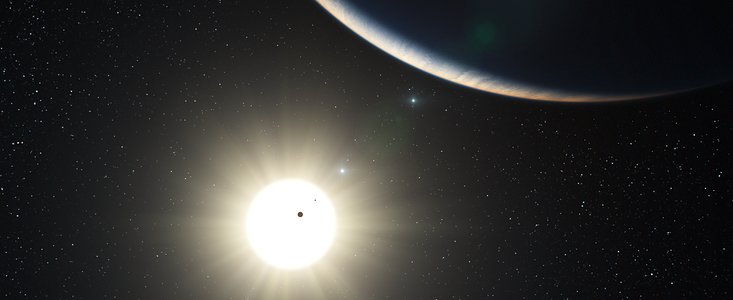 Clicca per allargarehttp://www.eso.org/public/archives/images/screen/eso1035a.jpg
Gli astronomi dell'ESO utilizzando lo strumento leader a livello mondiale per la caccia agli esopianeti, HARPS, hanno scoperto un sistema planetario con almeno cinque pianeti in orbita intorno ad una stella simile al nostro Sole, HD10180. I ricercatori hanno anche prove della presenza di due altri pianeti, uno dei quali avrebbe la massa più piccola fin qui trovata. Ciò renderebbe questo sistema simile al nostro Sistema Solare, almeno in termini di numero di pianeti (sette rispetto al nostro che è di otto pianeti). Inoltre, il team ha anche trovato prove che le distanze dei pianeti dalla loro stella seguono uno schema regolare, come anche accade nel nostro Sistema Solare.
"Abbiamo trovato quello che è il sistema con il maggior numero di pianeti finora scoperto", spiega Christophe Lovis, autore dell’articolo che riporta i risultati.
"Questa notevole scoperta evidenzia anche come stiamo entrando in una nuova era nella ricerca degli esopianeti: lo studio di complessi sistemi planetari e non soltanto dei singoli pianeti. Gli studi dei moti planetari nel nuovo sistema rivelano complesse interazioni gravitazionali tra i pianeti e ci dà la possibilità di intuire l’evoluzione a lungo termine del sistema." Il team di astronomi ha utilizzato lo spettrografo HARPS, aggiunto al telescopio da 3,6 metri dell'ESO a La Silla, in Cile, durante uno studio lungo sei anni della stella HD 10180, situata a 127 anni luce di distanza nella costellazione meridionale del Hydrus (il Serpente Marino). HARPS è uno strumento di misura di grande precisione senza pari ed è il cacciatore di pianeti extrasolari di maggior successo al mondo.
Grazie alle 190 misurazioni individuali condotte con HARPS, gli astronomi hanno individuato il lieve avanti e indietro nei movimenti della stella causato dal complesso di attrazioni gravitazionali di cinque o più pianeti. I cinque più forti segnali corrispondono a pianeti con masse simili a Nettuno - tra 13 e 25 masse terrestri
[1] - che orbitano attorno alla stella con periodi che vanno da 6 a 600 giorni. Questi pianeti si trovano tra 0,06 e 1,4 volte la distanza Terra-Sole dalla loro stella centrale.
"Abbiamo anche buone ragioni per credere che siano presenti altri due pianeti", dice Lovis. Uno sarebbe un pianeta simile a Saturno (con una massa minima di 65 masse terrestri) con un’orbita di circa 2.200 giorni. L'altro sarebbe il pianeta extrasolare mai scoperto di minor massa, circa 1,4 volte quella della Terra. È molto vicino alla sua stella ospite, solo il 2 percento della distanza Terra-Sole. Un "anno" su questo pianeta dura solo 1,18 giorni-Terra.
"Questo oggetto causa un tremolio della sua stella di soli circa 3 km/hour - più lento di passo d'uomo - e questo movimento è molto difficile da misurare", dice un membro del team, Damien Ségransan. Se confermato, questo oggetto sarebbe un altro esempio di un pianeta roccioso caldo, simile a Corot-7b (
eso0933).
Il sistema di pianeti scoperto di recente intorno a 10180 HD è unico sotto molti aspetti. Prima di tutto, con almeno cinque pianeti come Nettuno situati all'interno di una distanza equivalente a l'orbita di Marte, è un sistema più popolato del nostro sistema solare nella sua regione interna, e ha molti più pianeti di massa superiore
[2]. Inoltre, il sistema non ha particolari giganti gassosi simili a Giove. Inoltre, tutti i pianeti sembrano avere orbite quasi circolari.
Finora si era a conoscenza di quindici sistemi con almeno tre pianeti. L'ultimo detentore del record era 55 Cancro, con cinque pianeti, due dei quali pianeti giganti.
"Sistemi di pianeti di piccola massa, come quelli intorno a 10180 HD sembrano essere abbastanza comuni, ma la loro storia di formazione rimane un puzzle", dice Lovis.
Utilizzando la nuova scoperta, nonché i dati per altri sistemi planetari, gli astronomi hanno trovato un equivalente della legge di Titius-Bode, che esiste nel nostro Sistema Solare: le distanze dei pianeti dalla loro stella sembrano seguire uno schema regolare
[3].
"Questo potrebbe essere una firma del processo di formazione di questi sistemi planetari”, dice un membro del team Michel Mayor.
Un altro importante risultato trovato dagli astronomi durante lo studio di questi sistemi è che esiste una relazione tra la massa di un sistema planetario e la massa e il contenuto chimico della sua stella. Tutti i sistemi planetari molto massicci si trovano attorno a stelle di grande massa e ricche di metalli, mentre i quattro sistemi di minore massa si trovano attorno a stelle di minore massa e povere di metalli
[4]. Tali proprietà sembrano confermare gli attuali modelli teorici.
La scoperta verrà annunciata oggi al convegno
"Rilevamento internazionale e la dinamica di pianeti extrasolari in transito", presso l'Observatoire de Haute-Provence, Francia.
Note[1] Con il metodo della velocità radiale, gli astronomi possono solo stimare la massa minima di un pianeta perché la definizione della massa dipende anche dall'inclinazione del piano orbitale rispetto alla linea di vista, che è sconosciuta. Da un punto di vista statistico però, la massa minima è spesso vicina alla massa reale del pianeta.
[2] In media i pianeti nella regione interna del sistema HD 10180 hanno 20 volte la massa della Terra, mentre i pianeti interni del nostro Sistema Solare (Mercurio, Venere, Terra e Marte) hanno una massa media di metà quella della Terra.
[3] Per la legge di Titius-Bode le distanze dei pianeti dal Sole seguono uno schema semplice. Per i pianeti esterni, ogni pianeta è previsto essere di circa due volte più lontano dal Sole, che l'oggetto precedente. L'ipotesi ha correttamente previsto le orbite di Urano e di Cerere, ma non quella di Nettuno.
[4] Secondo la definizione utilizzata in astronomia, i "metalli" sono tutti gli elementi diversi da idrogeno ed elio. Metalli che, ad eccezione di pochissimi elementi chimici leggeri, sono stati tutti creati dalle varie generazioni di stelle. I pianeti rocciosi sono fatti di "metalli".
Maggiori InformazioniQuesta ricerca è presentata in Astronomy and Astrophysics (“The HARPS search for southern extra-solar planets. XXVII. Up to seven planets orbiting HD 10180: probing the architecture of low-mass planetary systems” by C. Lovis et al.).
Il team si compone di C. Lovis, D. Ségransan, M. Mayor, S. Udry, F. Pepe, e D. Queloz (Osservatorio di Ginevra, Svizzera), W. Benz (Università di Berna, Svizzera), F. Bouchy (Instituto d’Astrofisica di Parigi, Francia), C. Mordasini (Instituto per l’Astrononomia Max-Planck-, Heidelberg, Germania), N. C. Santos (Università di Porto, Portogallo), J. Laskar (Osservatorio di Parigi, Francia), A. Correia (Università di Aveiro, Portogallo), and J.-L. Bertaux (Università di Versailles Saint-Quentin, Francia) e G. Lo Curto (ESO).
L’ESO (European Southern Observatory) è la principale organizzazione intergovernativa di Astronomia in Europa e l’osservatorio astronomico più produttivo al mondo. È sostenuto da 14 paesi: Austria, Belgio, Repubblica Ceca, Danimarca, Finlandia, Francia, Germania, Italia, Olanda, Portogallo, Spagna, Svezia, Svizzera e Gran Bretagna. L’ESO mette in atto un ambizioso programma che si concentra sulla progettazione, costruzione e gestione di potenti strutture astronomiche da terra che consentano agli astronomi di fare importanti scoperte scientifiche. L’ESO ha anche un ruolo preminente nel promuovere e organizzare cooperazione nella ricerca astronomica. L’ ESO gestisce tre siti unici di livello mondiale in Cile: La Silla, Paranal e Chajnantor. A Paranal, l’ESO gestisce il Very Large Telescope, l’osservatorio astronomico nella banda visibile più d’avanguardia al mondo. L’ESO è il partner europeo di un telescopio astronomico rivoluzionario, ALMA, il più grande progetto astronomico esistente. L’ESO sta pianificando al momento un Telescopio Europeo Estremamente Grande ottico/vicino-infrarosso di 42 metri, l’E-ELT, che diventerà “il più grande occhio del mondo rivolto al cielo”.
Links[right]Source:
ESO - eso1035it - Scoperto un ...tema stellare ricco di pianeti 
[/right]
Richest planetary system discovered (w/ Video)August 24, 2010
 Enlarge
This artist's impression shows the remarkable planetary system around the Sun-like star HD 10180. Credit: ESO
(PhysOrg.com) -- Astronomers using ESO's world-leading HARPS instrument have discovered a planetary system containing at least five planets, orbiting the Sun-like star HD 10180. The researchers also have tantalising evidence that two other planets may be present, one of which would have the lowest mass ever found. This would make the system similar to our Solar System in terms of the number of planets (seven as compared to the Solar System's eight planets). Furthermore, the team also found evidence that the distances of the planets from their star follow a regular pattern, as also seen in our Solar System. “We have found what is most likely the system with the most
planets yet discovered,” says Christophe Lovis, lead author of the paper reporting the result. “This remarkable discovery also highlights the fact that we are now entering a new era in exoplanet research: the study of complex planetary systems and not just of individual planets. Studies of planetary motions in the new system reveal complex gravitational interactions between the planets and give us insights into the long-term evolution of the system.”
The team of astronomers used the HARPS spectrograph, attached to ESO’s 3.6-metre telescope at La Silla, Chile, for a six-year-long study of the Sun-like star HD 10180, located 127 light-years away in the southern constellation of Hydrus (the Male Water Snake). HARPS is an instrument with unrivalled measurement stability and great precision and is the world’s most successful exoplanet hunter.
Thanks to the 190 individual HARPS measurements, the astronomers detected the tiny back and forth motions of the star caused by the complex gravitational attractions from five or more planets. The five strongest signals correspond to planets with Neptune-like masses — between 13 and 25 Earth masses -- which orbit the star with periods ranging from about 6 to 600 days. These planets are located between 0.06 and 1.4 times the Earth-Sun distance from their central star.
This animation shows an artist’s impression of the remarkable planetary system around the Sun-like star HD 10180. Credit: ESO
“We also have good reasons to believe that two other planets are present,” says Lovis. One would be a Saturn-like planet (with a minimum mass of 65 Earth masses) orbiting in 2200 days. The other would be the least massive exoplanet ever discovered, with a mass of about 1.4 times that of the Earth. It is very close to its host star, at just 2 percent of the Earth-Sun distance. One “year” on this planet would last only 1.18 Earth-days.
“This object causes a wobble of its star of only about 3 km/hour— slower than walking speed — and this motion is very hard to measure,” says team member Damien Ségransan. If confirmed, this object would be another example of a hot rocky planet, similar to Corot-7b.
The newly discovered system of planets around HD 10180 is unique in several respects. First of all, with at least five Neptune-like planets lying within a distance equivalent to the orbit of Mars, this system is more populated than our Solar System in its inner region, and has many more massive planets there. Furthermore, the system probably has no Jupiter-like gas giant. In addition, all the planets seem to have almost circular orbits. On average the planets in the inner region of the HD 10180 system have 20 times the mass of the Earth, whereas the inner planets in our own Solar System (Mercury, Venus, Earth and Mars) have an average mass of half that of the Earth.
So far, astronomers know of fifteen systems with at least three planets. The last record-holder was 55 Cancri, which contains five planets, two of them being giant planets. “Systems of low-mass planets like the one around HD 10180 appear to be quite common, but their formation history remains a puzzle,” says Lovis.
 Enlarge
This image shows a close-up of the sky around the star HD 10180. The picture was created from photographs taken through red and blue filters and forming part of the Digitized Sky Survey 2. The field of view is approximately eleven arcminutes across. The blue and orange halos around the star, and the eight spikes of light, are artifacts of the imaging process and are not real. The remarkable planetary system around this star is far too faint and close in to be visible in this image. Credit: ESO and Digitized Sky Survey 2. Acknowledgment: Davide De Martin
Using the new discovery as well as data for other planetary systems, the astronomers found an equivalent of the Titius-Bode law that exists in our
Solar System: the distances of the planets from their star seem to follow a regular pattern. “This could be a signature of the formation process of these planetary systems,” says team member Michel Mayor.
The Titius-Bode law states that the distances of the planets from the Sun follow a simple pattern. For the outer planets, each planet is predicted to be roughly twice as far away from the Sun as the previous object. The hypothesis correctly predicted the orbits of Ceres and Uranus, but failed as a predictor of Neptune's orbit.
Another important result found by the astronomers while studying these systems is that there is a relationship between the mass of a
planetary system and the mass and chemical content of its host star. All very massive planetary systems are found around massive and metal-rich stars, while the four lowest-mass systems are found around lower-mass and metal-poor stars. Such properties confirm current theoretical models. According to the definition used in astronomy, “metals” are all the elements other than hydrogen and helium. Such metals, except for a very few minor light chemical elements, have all been created by the various generations of stars. Rocky planets are made of "metals".
This animation shows how astronomers use very precise spectrographs such as the HARPS instrument on the 3.6-metre telescope at La Silla, Chile to find exoplanets. As the planet orbits its gravitational pull causes the parent star to move back and forth. This tiny radial motion shifts the observed spectrum of the star by a correspondingly small amount because of the Doppler shift. With super-sensitive spectrographs such as HARPS the shifts can be measured and used to infer details of a planet’s mass and orbit. Credit: ESO
The discovery is announced today at the international colloquium “Detection and dynamics of transiting exoplanets”, at the Observatoire de Haute-Provence, France.
Provided by ESO (
news :
web)
[right]Source:
Richest planetary system discovered (w/ Video) [/right]

 Login
Login Chat [0]
 FAQ
FAQ Cerca
Cerca